BasCal
Solo developer · AI-assisted development
Locally hosted · Successfully defended
Turning an academic research framework into a learning platform, with 12 calculus modules, adaptive quizzes, and student progress analytics.
- Node.js
- Express
- MySQL
- Perplexity API
June–July 2026
From a learning objective to a reviewed quiz.
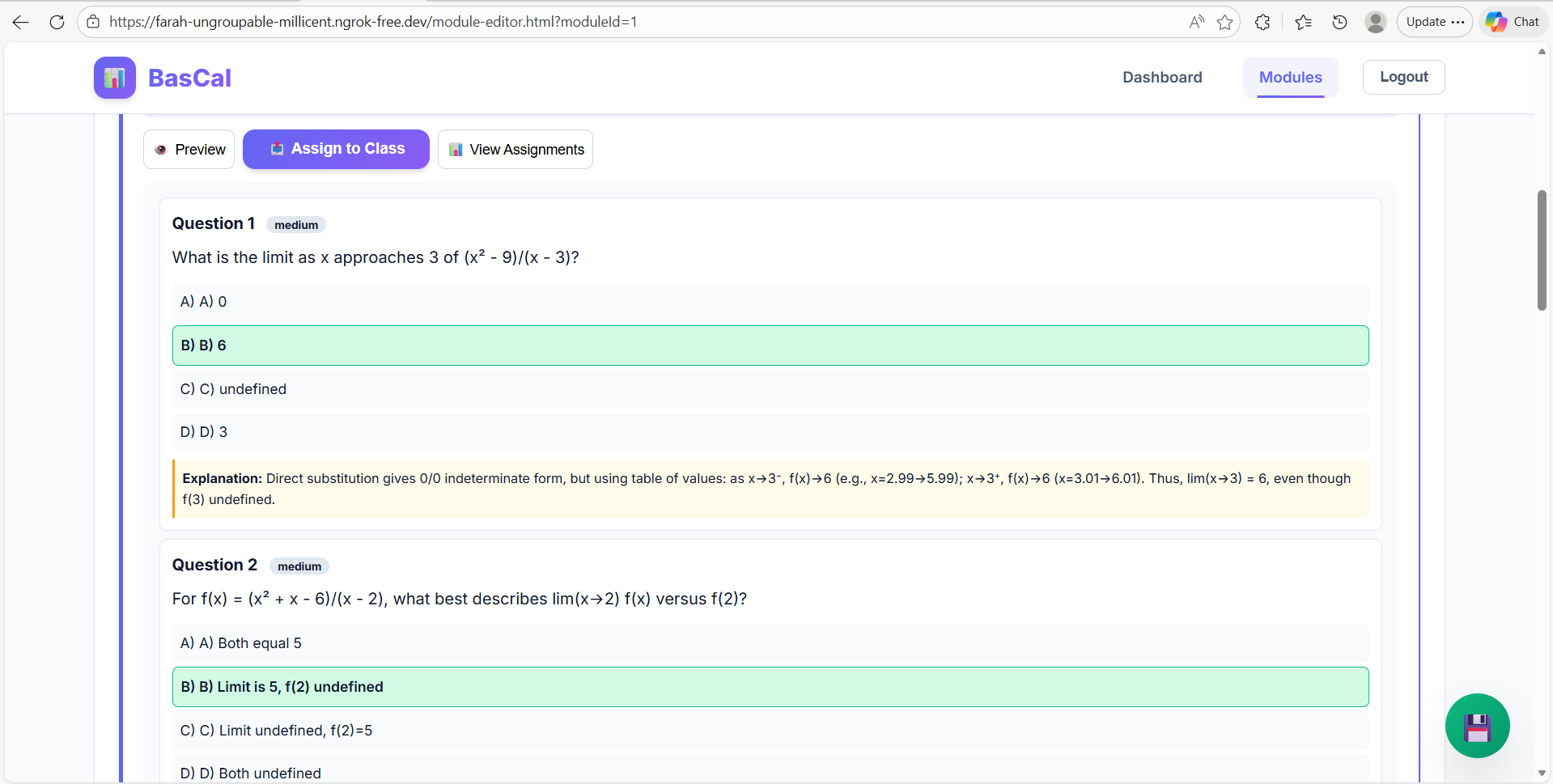
Choose a step to follow the workflow. Markers highlight the relevant part of each original screenshot.
A design decision
AI generation sits inside a teacher review workflow. The interface saves a generated quiz as a draft so questions can be previewed and edited before approval and assignment.
The tradeoff
Generation can assist authoring, but educators still need to check correctness and alignment with the learning objectives.
The brief
BasCal was commissioned for a professor’s master’s thesis at Batangas State University. I translated the research requirements into student and educator workflows rather than independently originating the research framework.
The application
The platform covers differentiation and integration through 12 modules, adaptive quizzes, learning materials, and progress analytics across five mathematical proficiency strands. Educators can manage content and review generated quizzes.
The challenge
AI integration and incorrectly displayed mathematical equations were the hardest parts. Quiz generation needed both usable output and readable calculus notation.
How I approached it
I researched forum discussions, took notes on other developers’ solutions, and adapted relevant approaches to my application. The quiz workflow supports LaTeX notation for mathematical expressions.
Delivery and feedback
I developed the system with AI-assisted programming, hosted it locally, and used ngrok to make it accessible during the successful defense. The professor appreciated the features and told me, “Nak, maraming salamat ha.” This feedback reflects the delivery experience; learning outcomes were not measured here.
What I learned through this project
The experience I take into the next project: technical decisions, practical tradeoffs, and ways of working.
Researching unfamiliar integrations
I learned to compare forum examples, keep notes, and adapt solutions to my own application instead of assuming an example would work unchanged.
Making mathematical content readable
Working on AI quizzes taught me that generating content is only one step: equations also need consistent notation, rendering, and a teacher review workflow.
Delivering an academic brief
I gained experience turning research requirements into a usable application and distinguishing a local defense demonstration from ongoing production hosting.
Inside the application
A closer look at the project.