Silong Hamuros
Project Manager · Main Project Feature Lead · Application Feature Lead · Team project
Functional Android prototype · Hardware pending
A six-member team project with a functional Android prototype for coffee-drying monitoring, batch records, weather advisories, and control workflows. Physical hardware testing is still ahead.
- Flutter
- Dart
- Open-Meteo
- Node.js
- SQLite
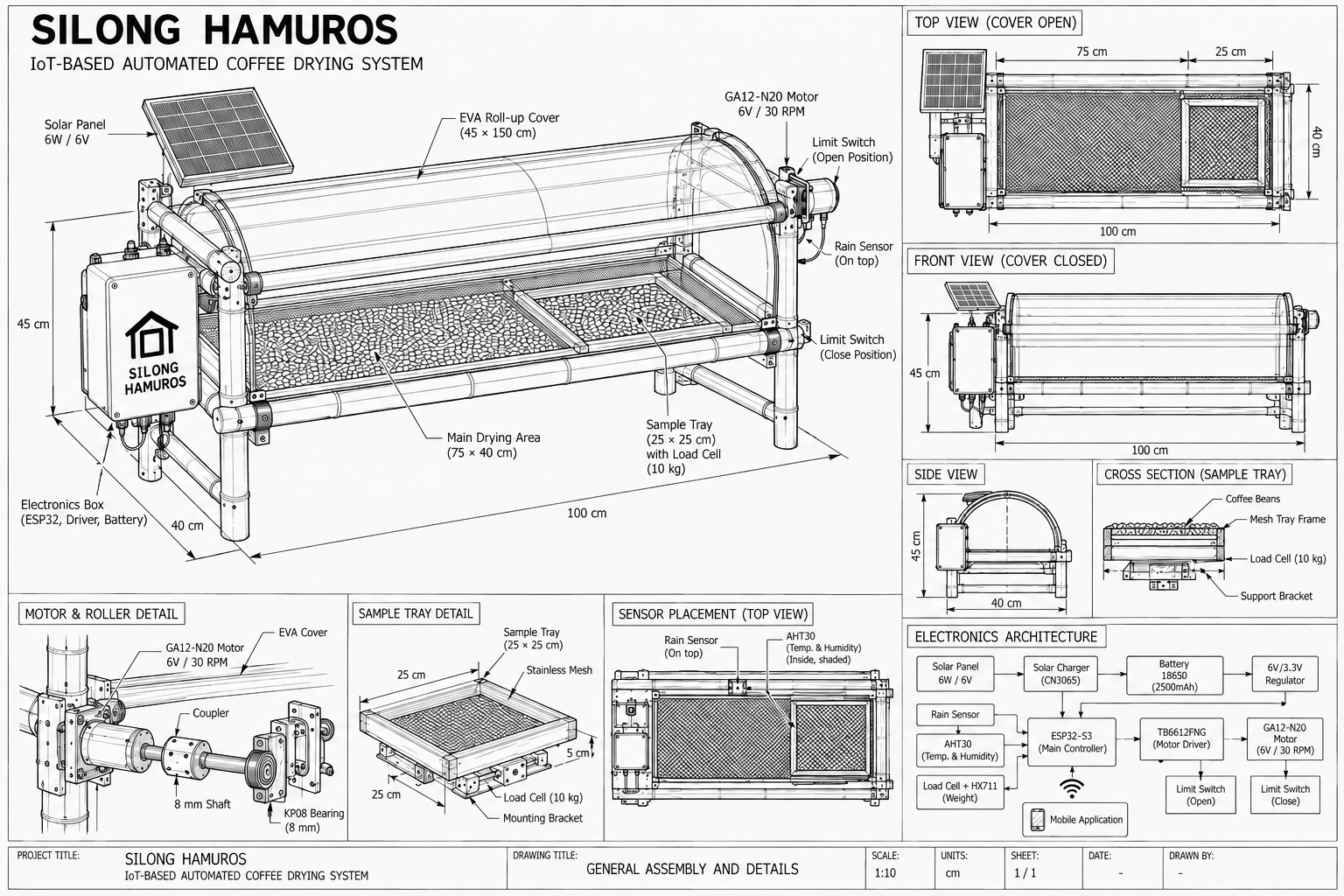
- Planned ESP32
Started October 2026 · Six-member team
The problem
Silong Hamuros explores digital monitoring and a planned protective cover for Kapeng Barako drying. Unexpected rain can require farmers to intervene quickly to protect drying beans.
My role and attribution
As Project Manager, Main Project Feature Lead, and Application Feature Lead, I conceptualized most of the planned prototype’s features and help develop application workflows. A teammate contributed the original coffee-drying concept and conceptualized the API service for other weather stations. The project is a collaboration among six members.
Monitoring and batch workflows
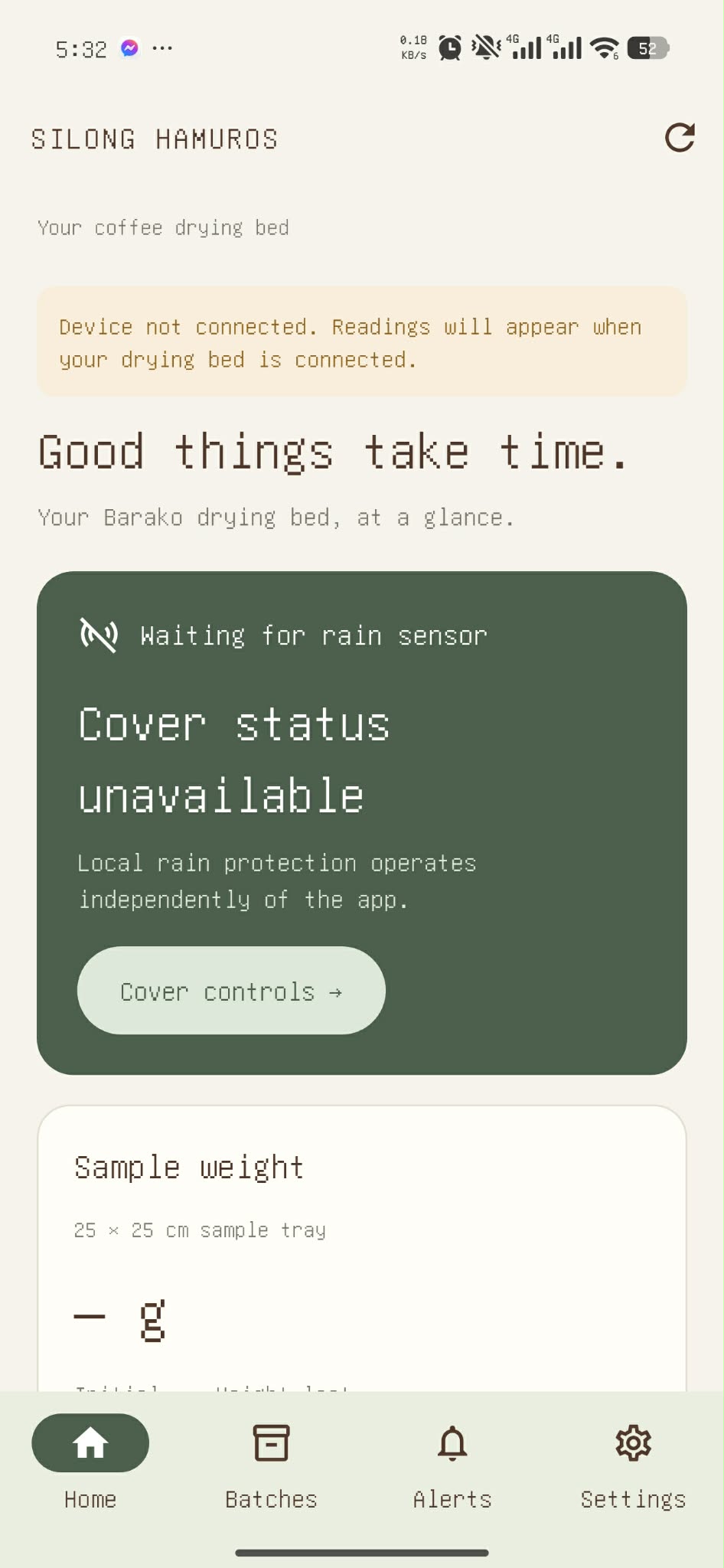
The Android prototype implements a dashboard for sample weight, weight loss, temperature, humidity, rain, and cover position when a device is connected. Batch workflows include start/end actions, initial and final weight, elapsed time, notes, and optional manual moisture-meter readings, alongside trend charts and batch history.
Controls and event records
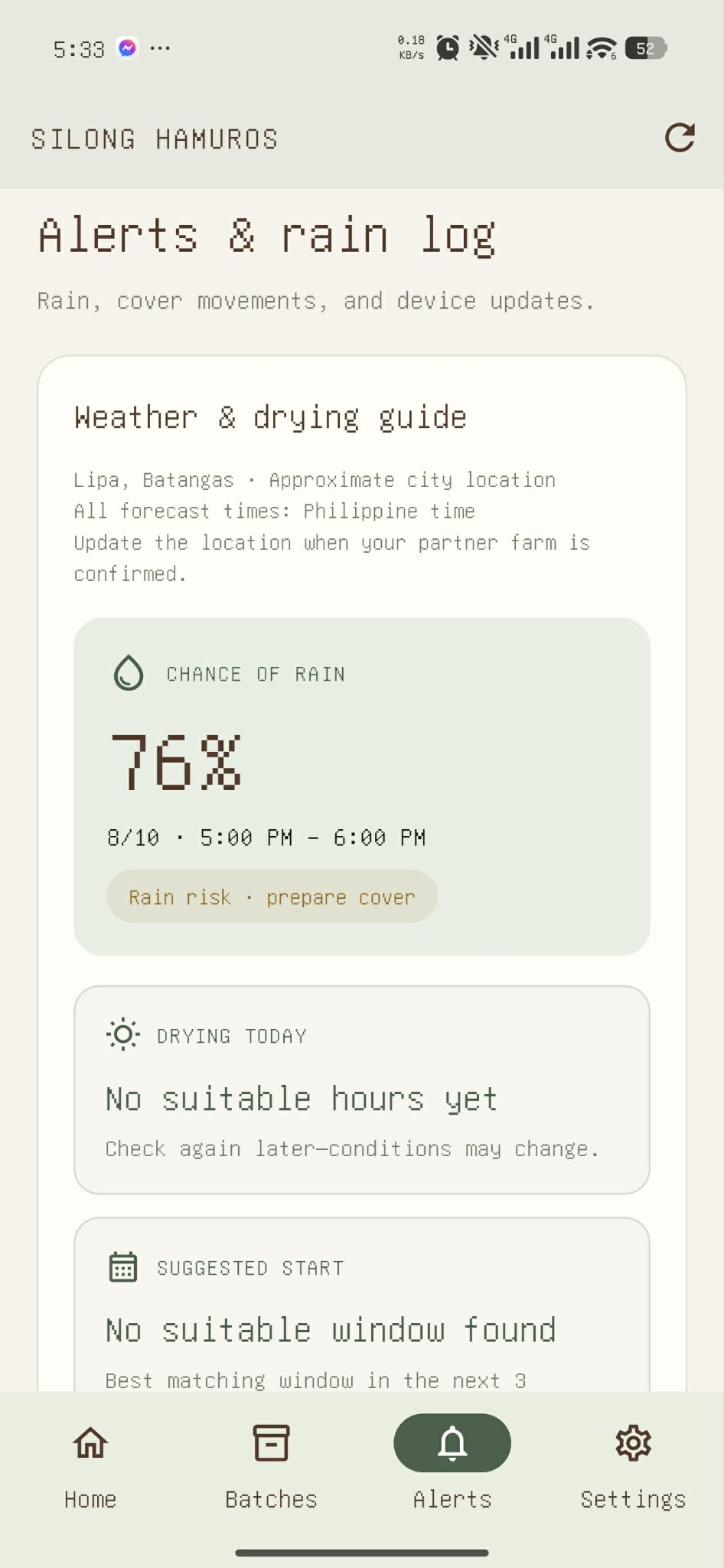
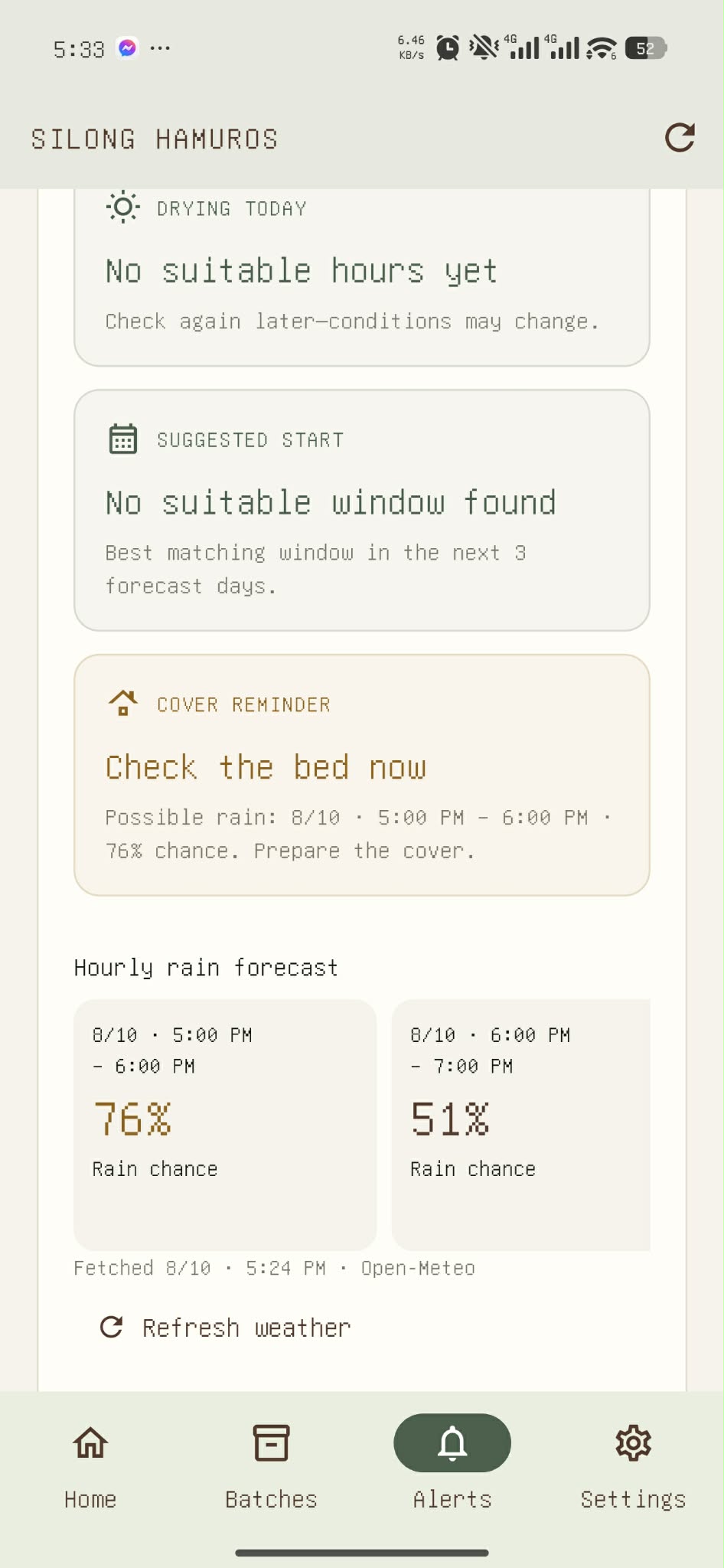
Open, Close, Stop, and Resume workflows include checks for rain, a disconnected device, stale readings, and faults. Alerts and rain logs cover rain events, cover movements, and device updates. These application workflows still require physical ESP32 and motor validation.
Weather and farm settings
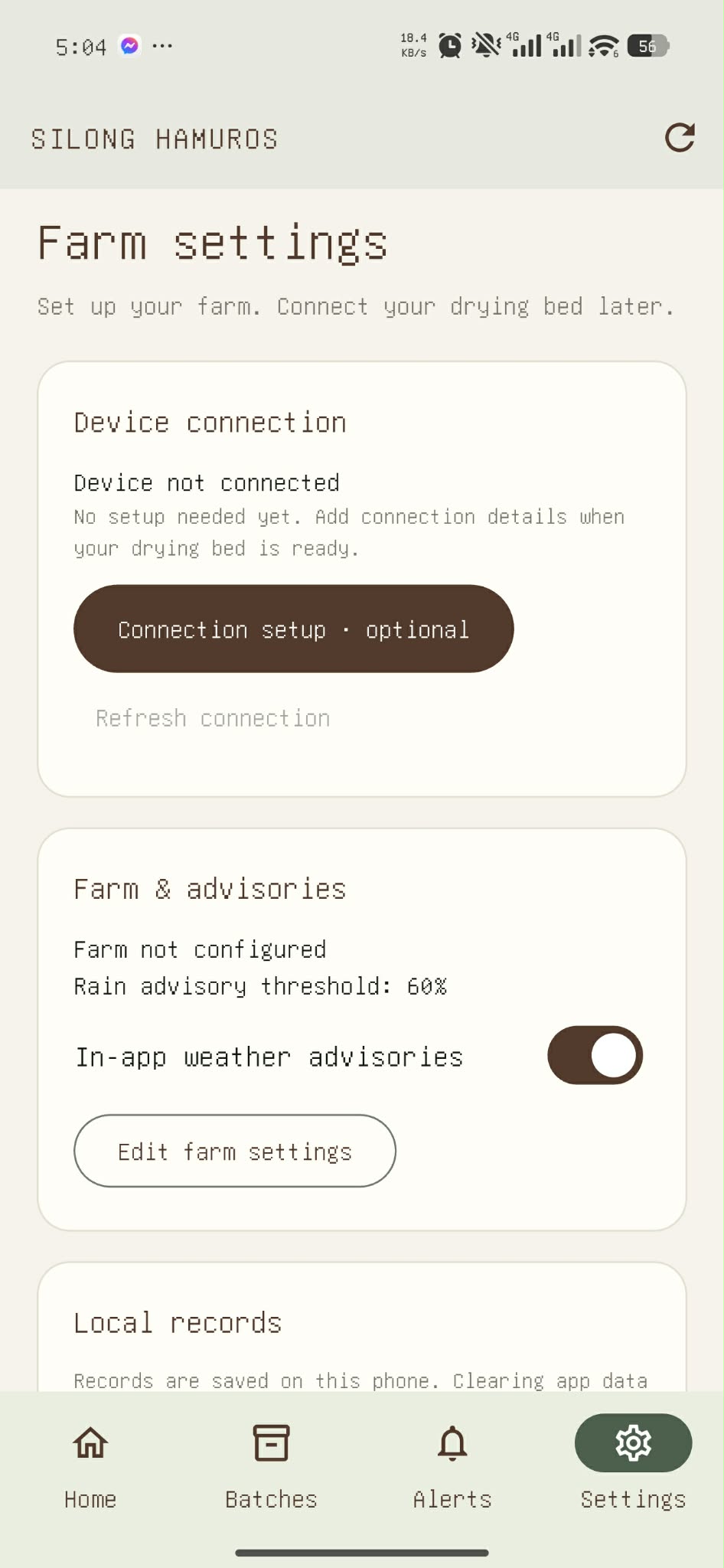
Open-Meteo forecasts work independently of hardware with an internet connection. They provide rain probability, hourly forecasts, experimental drying-window suggestions, and in-app reminders. Farm settings include the name, coordinates, advisory threshold, and advisory toggle. Background push notifications are not implemented.
Storage and integration
The application saves records and settings locally on the phone and can copy records as JSON. A companion backend provides token-based API connections and SQLite storage.
Costing and support
Costing is a major development challenge. After our idea presentation, our professor offered ₱5,000 toward development. This is an offer of support, rather than a claim that funding has already been received or that the costing challenge is resolved.
Development status
The software is a functional Android prototype. No physical hardware prototype has been built, and end-to-end sensing or motor control has not been validated. Drying suggestions remain experimental and need validation in actual drying conditions.
Security decisions
The Android app stores its access token using secure storage and requires an HTTPS backend URL in release configuration. The companion backend separates app and device credentials and restricts routes by role: device credentials submit telemetry, while app credentials request controls. It also validates input and uses parameterized SQLite statements.
Security work still ahead
The current integration is a prototype. A production setup still needs token rotation and revocation, API rate limiting, deployment verification, and physical-device testing. Implemented safeguards do not establish end-to-end hardware security or a completed security assessment.
What I learned through this project
The experience I take into the next project: technical decisions, practical tradeoffs, and ways of working.
Connecting application features to physical behavior
I gained experience planning how monitoring, device freshness, faults, and control requests should fit together, while keeping implemented software separate from untested hardware behavior.
Partnership and business communication
Exploring the agricultural use case helped me practice talking with businesses and considering potential partnerships alongside technical development.
Developing an application as a team
I learned to translate feature ideas into application workflows, coordinate responsibilities, and acknowledge the original concept and weather-service contribution of a teammate.
Planning within financial constraints
Costing made me consider feasibility alongside the feature list. The professor’s offer of support is encouraging, but the build still needs a practical budget and hardware validation.
Security review history
Dated findings and follow-up evidence. Review items are distinguished from confirmed vulnerabilities and verified fixes.
Plan production credential management
The prototype separates app and device credentials. Token rotation, revocation, and API rate limiting remain production milestones.
Validation: Source inspected; no production security assessment or physical-device validation performed.
Application & proposed system
A closer look at the project.